Tuesday, 28 June 2011

Harvesting Willow


Had a great day today harvesting willow with the Andy and the students from Horticap. We were given permission to harvest the willow from private land at a beautiful spot in Dallowgill, Kirkby Malzaerd.The willow will  be used as part of an arts week I will be doing with year 6 of the Parish Church Primary School in Skipton. The plan is to construct a willow sculpture in the grounds of the school. Keeping in the concept of shelter and safety (the original inspiration for the Horticap sculpture “Refuge”) my initial ideas are to construct three dome shaped structures all slightly smaller than each other that represent the different stages of the children going through the years of primary school. The sculptures will be large enough to climb into and will act as forms of dens for the children!
Special thanks to Andy for organising the job, Jenny for her permission to harvest the willow from her land, her sister Rachael and of course the students for all their hard work, hope you enjoyed the day as much as I did!

Monday, 20 June 2011

Land Art


                             Michael Heizer
                                       "Double Negative" 1969 Mormon Mesa, Nevada


"Rift 1" 1968  Nevada Desert


Film stills of Robert Smithson's "Spiral Jetty" 1970

Robert Morris "Observatory" 1970 Netherlands
Land Art originated in the USA in the late 1960’s. The success and subsequent failure of modernism combined with a mixture of events such as the first images of the earth from space from the Apollo 8 mission in 1968, the Vietnam War, the threat of a nuclear war and the danger of a population explosion  sparked an intense and emotional response from artists.  The realization of how precious human existence is led this new art form to directly engage with the physicality of the earth itself. By manipulating the landscape artists were able to validate the acceptance of the environment around us and make a physical mark on the world; validating the presence of humanity. The vastness of some of the Land Art works is compelling and very powerful. The earth and the materials the land provides are mediums I very much engage with.

Thursday, 12 May 2011

Colidere Exhibition (The meeting or clash between people)


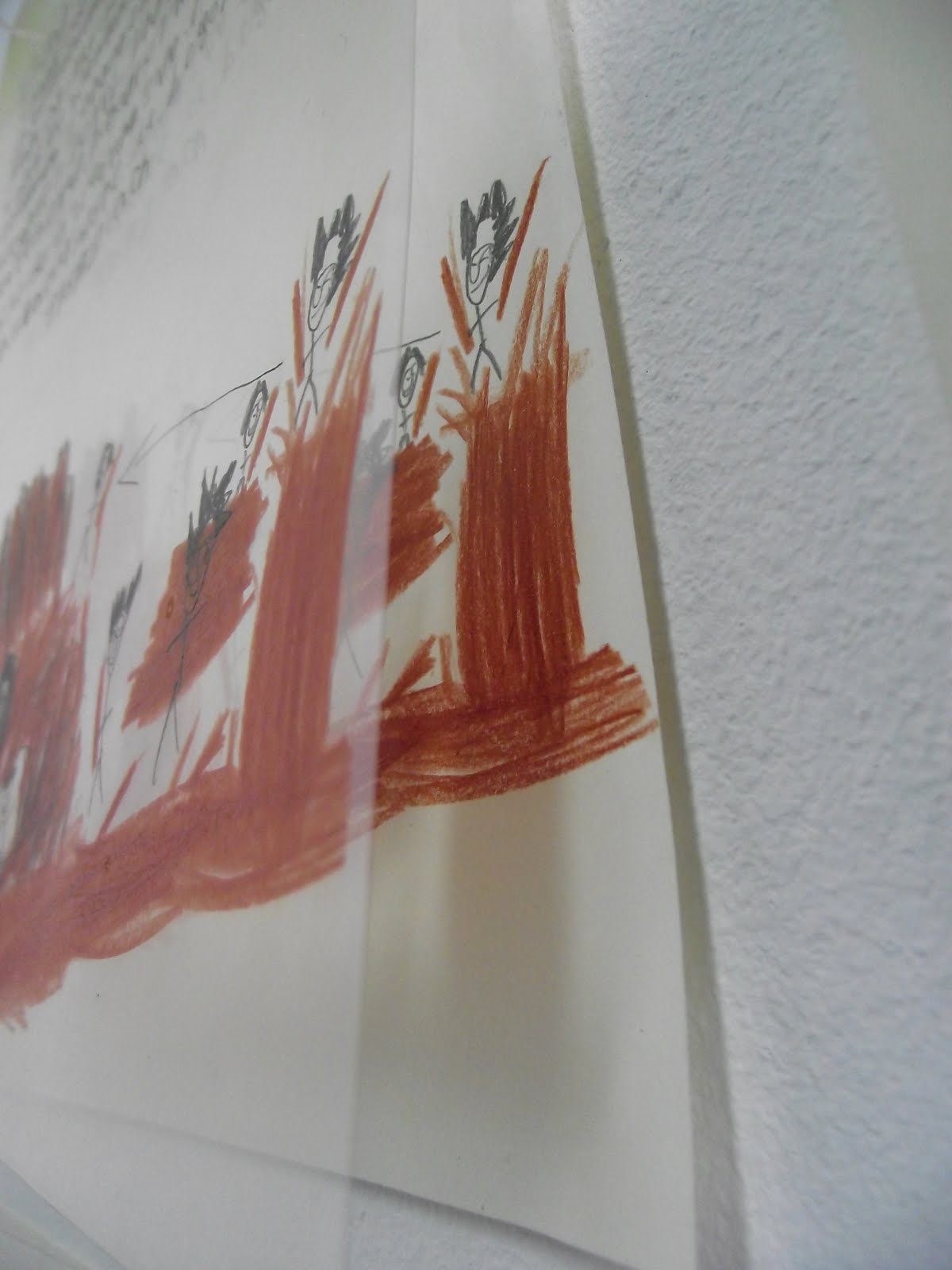
To celebrate the final of the Collaborative brief Level 5 of the Art & Design Interdisciplinary course put on a short exhibition to show some of our work. I chose to display the fabulous letters Beckwithshaw primary school sent me thanking me for their visit to the willow sculpture back in March. In the beginning I was reluctant to use the original letters, but while copying them on to acetate I noticed how the overlapping of the text and pictures gave an interesting double layering effect. I also liked the idea that the acetate was protecting the originals and the way this reflected the shelter and saftey concept of the willow sculpture.

Tuesday, 26 April 2011

Object Elective


I have been developing my work further through an elective which was based on the the use of consumable and throw away materials. The intention was to create an object which would qualify as a 'sculptural expression'. The elective gave me the chance to explore many different processes using materials such as twigs, bark chippings and organic canvas which I had previously produced in my Collaborative project.
The images above are one of the outcomes of the week. Small incisions were made into the length of the large twigs. These were then fixed into dome shaped plaster as bases. Using old reels of cotton I wound the thread from branch to branch using the incisions to keep a tension on the work.Subconsciously i was realizing voids of negative spaces which appropriates the rural landscape; the shapes and forms of the land.

 The images here are the result of the organic canvas being wrapped around chicken wire and the direct application of heat from a heat gun onto it's surface. This has produced an interesting aesthetic transformation of a 2D surface into a 3D texture. The work does have historical and archeology connotations and I am drawn to the element of heat and fire as a medium.

Saturday, 16 April 2011

Rural Environment from above

These images from Google Earth highlight the immense mark humanity leaves on the rural environment. The satellite imagery produced highlights the penetration of the land and the patterns and forms that result in these interventions.These marks are made through the cultivation and the physical actions of penetrating the earth. The traces are shaped through the repetitive process of planting crops and the track marks left from the machinery used to carry out the procedure.
 

Rural Landscapes


The presence of mankind's intervention with the land is visible in these images. The cultivation of the land involves the penetration of the earth to enable the growth of crops. The building of dry stone walls creates the sectioning of the land forming areas for grazing animals. These textured surfaces and three dimensional forms leave the traces and evidence of humanity. For me, the exciting thing about these landscapes is their vastness and the immensity of mankind's ability to transform the landscape through the labour of agriculture and farming.